
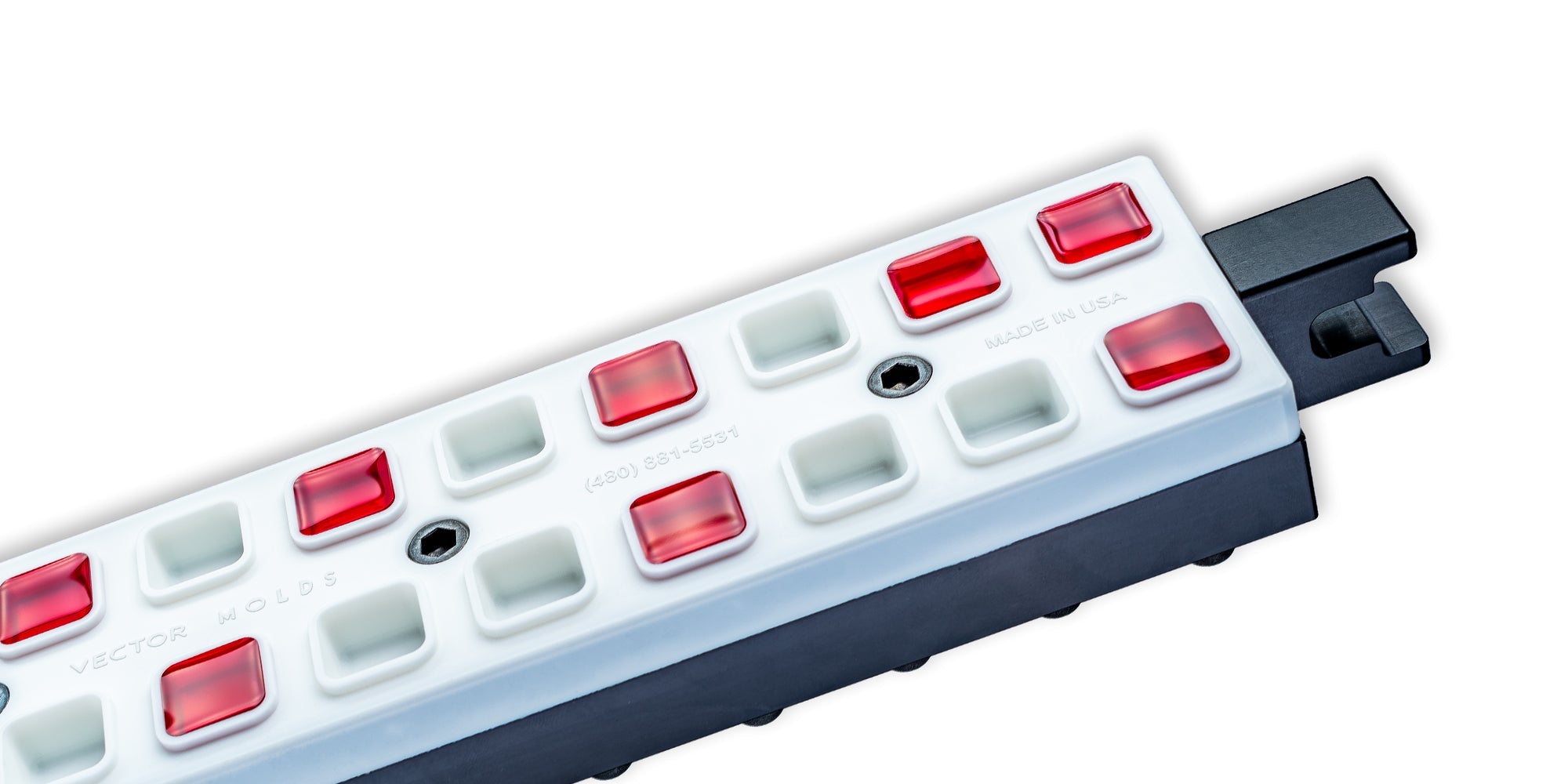
The Hidden Bottleneck in High-Speed Gummy Production: How Integrated Ejector Systems Save Copacker Workflows.
When a confectionery brand transitions from high-output artisan kitchens to large-scale contract packaging, the conversation usually centers on automated depositor compatibility and pump-head nozzle alignments.
But ask any industrial plant manager about their true operational nightmare, and they will give you a single answer: demolding drag.
When running massive commercial batches around the clock, standard static molds can create a mechanical micro-lag during the automated stripping phase. If a sticky pectin formulation or a highly concentrated active nutraceutical blend clings to a cavity wall for even a fraction of a second, the consequences are immediate:
-
Product Tearing: Ruined aesthetics that fail quality control inspections.
-
Line Flashing & Residue: Residual slurry buildup that forces an unscheduled line shutdown for manual washing.
-
Mechanical Stress: Premature wearing on automated mechanical sweeps and conveyor arms.
To achieve a truly seamless, 24/7 retail-ready distribution workflow, commercial manufacturing requires a smarter evolution in tooling: Molds engineered specifically for automated ejector systems.
The Vector Molds Difference: Advanced CAD Production Engineering
At the enterprise level, a mold is not just a shape—it is a critical mechanical component of an automated assembly line. This is why our Advanced CAD Production Engineering team approaches mold development with production-focused engineering strategies. We understand industrial manufacturing from the inside out.
Our engineering department develops custom mold layouts using advanced programming to ensure your tooling lines up flawlessly with your mechanical hardware. By using Precision CNC-Machined Master Tooling and advanced CNC machining, we eliminate the dimensional variance that plagues cheap, hand-poured alternatives.
Overcoming Demolding Drag with Precision Geometry
Traditional manual workflows rely on the physical flexibility of silicone grids for hand-peeling or manual scraping. However, automated large-scale extraction lines use mechanical strike plates, pins, or automated vacuum plates to instantly punch or pull the set gelatins out of the tooling.
If your mold supplier does not understand high-speed automated extraction, the automated pins will push through the mold or warp the cavity over time. Our team solves this by implementing Precision Demolding Geometry—engineered cavity lines specifically designed to improve release performance during high-speed mechanical sweeps without losing sharp detail definition.
Technical Spotlight: Built for the Machine
Our proprietary manufacturing technologies directly address the pain points of automated, multi-shift operations:
-
Vector PolishedFlow Technology: Precision-machined polished cavities engineered for smooth release and sharp detail. The Vector PolishedFlow Finish improves release performance while maintaining sharp detail and production efficiency.
-
PrecisionFill Geometry: Optimized cavity engineering for repeatable fill consistency and production accuracy. This PrecisionFill Cavity Engineering is designed to support consistent fill distribution and repeatable results across large manufacturing runs.
-
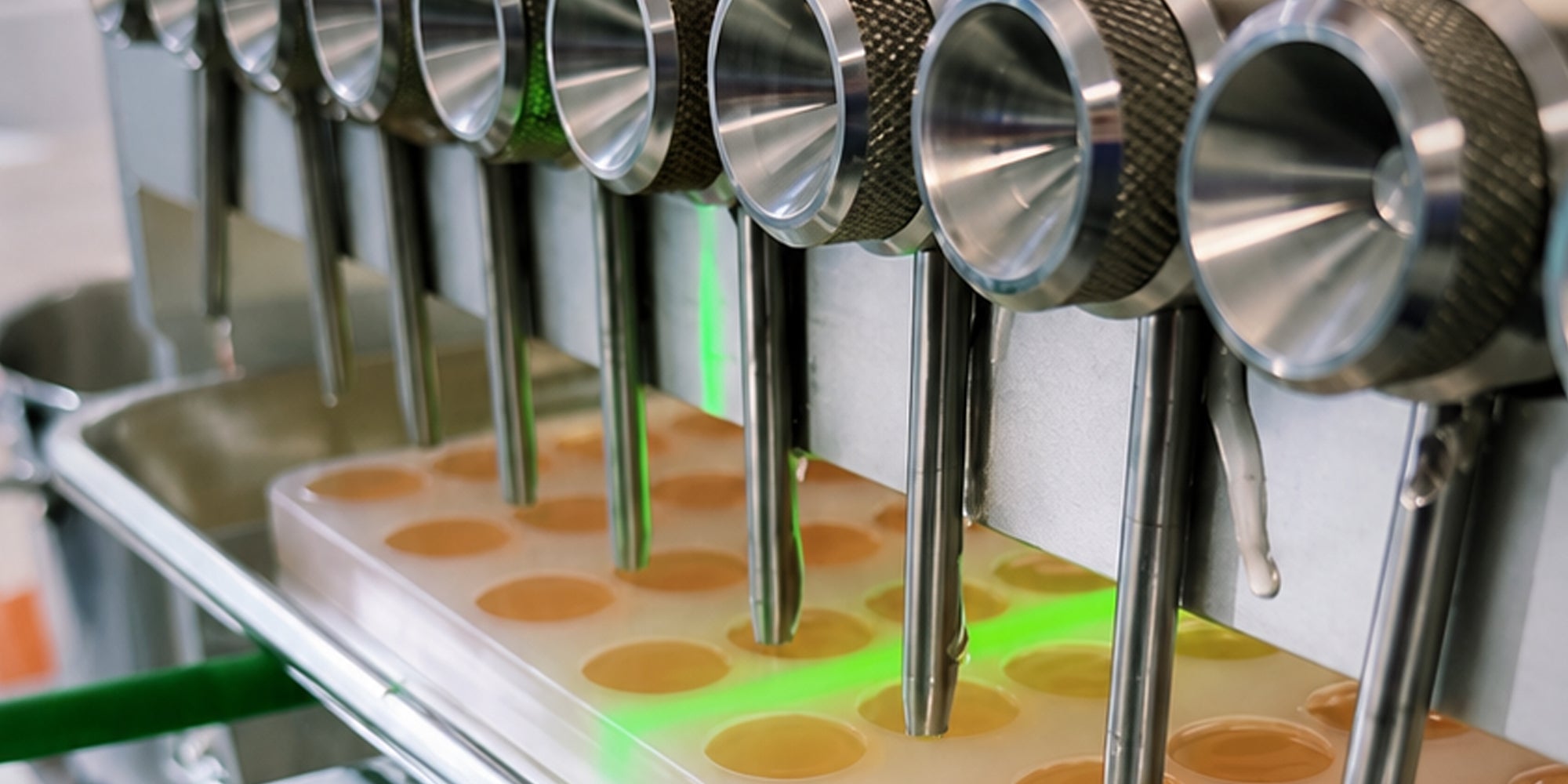
Depositor-Ready Production Layouts: Mold sheets engineered for compatibility with automated production systems, depositor workflows, and scalable manufacturing operations.
-
Vector MultiFlow Layout Optimization: Optimized cavity spacing and tray geometry designed to maximize production efficiency, offering MultiFlow Production Layouts that streamline filling operations.
The Anatomy of an Ejector-Compatible Industrial Mold
To handle the continuous force of automated demolding machinery, our engineering team utilizes a rugged structural layout:
-
Hygienic Non-Porous Surface Technology: High-density platinum silicone designed for easy cleaning, ultra-low residue retention, and efficient production workflows.
-
Platinum-Cured Production Silicone: Engineered using food-grade platinum silicone designed for commercial confectionery and nutraceutical manufacturing environments. This ProductionCycle Durability ensures our molds withstand continuous production cycles, repeated heat exposure, cooling processes, and daily commercial use.
What This Means for Commercial Copackers & Recipe Scaling
For contract packagers handling corporate clients, every second of line downtime equates to lost revenue. Moving away from standard static sheets and adopting automated molds with integrated ejector systems directly optimizes your operational KPIs:
-
Maximizes Throughput: Speeds up your demolding cycle times by up to 40%, allowing automated packaging lines to run at maximum mechanical capacity.
-
Ensures Strict Quality Control: Eliminates human error and physical touch points during the demolding phase, maintaining impeccable sanitary compliance and structural shape consistency.
-
Reduces Tooling Overhead: Molds engineered explicitly to absorb the impact of automatic ejector pins last significantly longer than generic templates repurposed for industrial machines.
Partner with our Industrial Engineering Team
Backed by 9 years of market-tested durability in commercial confectionery tooling, our team develops automatic big machine molds with integrated ejector systems. Whether you are setting up a brand-new automated factory line or upgrading your current universal depositor system to an active ejection layout, our engineering team provides the precision required to maximize your output.
Ready to eliminate demolding bottlenecks? Contact our industrial engineering division today to scale your automated production.
Frequently Asked Questions
Industrial Tooling & Ejector Systems FAQ
Q1: What exactly is an automated mold ejector system, and how does it work?
A: An automated ejector system replaces manual mold twisting or scraping with automated mechanical extraction. As the mold tray advances along the conveyor belt to the demolding station, a synchronized mechanical strike plate equipped with precision-aligned push-pins presses against the back of the mold. This instantly pops the candies out onto a collection belt or cooling tray without stretching the silicone or relying on manual labor.
Q2: Why can't I use standard hand-pour half sheets on an automated extraction line?
A: Standard sheets are designed for manual flexibility, meaning they lack the rigid structural boundaries required to lock into automated conveyor carriers. Under the repetitive force of a mechanical ejector plate, a standard hand-pour sheet will warp, bend, or slip out of alignment, causing pin misfires, damaged cavities, and costly line jams. Automated systems require specialized Advanced CAD Production Engineering to handle continuous physical stress.
Q3: What is the difference between industrial food-grade silicone and your Platinum-Cured Production Silicone?
A: While standard food-grade silicone often contains chemical fillers that degrade under intense thermal cycles, our Platinum-Cured Production Silicone is a laboratory-grade formulation. It is completely inert, entirely BPA-free, and leaves zero chemical residue. This provides superior dimensional stability, ensuring that each cavity retains its exact milliliter capacity over hundreds of thousands of production cycles without losing its non-stick properties.
Q4: How does Vector PolishedFlow Technology help with sticky pectin or functional formulations?
A: Pectin and highly concentrated nutraceutical slurries are naturally prone to surface bonding, causing them to stick to unpolished silicone walls. Our Vector PolishedFlow Technology applies a mirror-smooth finish to the interior of each cavity. This drastically lowers surface friction, allowing the set candy to release immediately under mechanical pin pressure without tearing or requiring excess release oils.
Q5: Can your engineering team adapt custom shapes to fit an existing Universal Depositor layout?
A: Yes. Through our Vector MultiFlow Layout Optimization, our engineering team uses advanced software to map your custom shapes (whether novelty, botanical, or geometric) into highly efficient grid matrices. We precisely match the spacing of your specific machine's pump-head nozzles to ensure absolute compatibility and seamless recipe scaling.
Q6: What temperature extremes can your ProductionCycle Durability silicone withstand?
A: Our production silicone is engineered to transition instantly from heavy heat depositing to rapid cryogenic blast freezing. It safely withstands continuous operating temperatures ranging from -40°C up to 240°C (-40°F to 464°F)without warping, cracking, or experiencing any structural breakdown.
Q7: What is "flashing," and how does PrecisionFill Cavity Engineering prevent it?
A: "Flashing" occurs when excess slurry overflows a cavity, creating unwanted thin webs of candy skin that connect separate pieces on a tray. PrecisionFill Cavity Engineering designs the upper lips and perimeter borders of the cavities to manage liquid surface tension smoothly. This feature works alongside automated depositor pumps to distribute fill volume cleanly and evenly, completely eliminating messy flashing across large manufacturing runs.
Q8: How does Hygienic Non-Porous Surface Technology cut down on cleaning downtime for copackers?
A: Traditional low-grade silicone has micro-pores that trap active ingredients, cross-contaminants, and residue, requiring long soaking and washing cycles between batches. Our high-density Hygienic Non-Porous Surface Technology stops material absorption completely. The smooth, non-porous finish allows for fast clean-in-place (CIP) processes, reducing cleaning times between active runs and preventing cross-batch ingredient carryover.
Q9: What role does CNC PrecisionCore Tooling play in ensuring active dosing accuracy?
A: For nutraceutical and supplement brands, consistent dosing is a non-negotiable legal requirement. Our master molds are cut via CNC PrecisionCore Tooling, a high-detail programming process that maintains tolerances within fractions of a millimeter. This extreme mechanical accuracy ensures that every cavity across a multi-tray system holds an identical volume, protecting your brand from active dosing variances.
Q10: How long do Vector molds last under continuous, multi-shift manufacturing conditions?
A: While cheap consumer molds fail within a few weeks of automated use, our industrial molds are built specifically for ProductionCycle Durability. Backed by 9 years of market-tested durability, our platinum-cured systems are engineered to perform reliably through thousands of continuous runs under automated mechanical strike plates, offering an incredibly low cost-per-pour.
Share:
Calibrated Uniformity: Commercial Silicone Mold Layouts for Nutraceutical Gummy Production
Custom Tooling & Advanced CAD Production Engineering for Leading Candy Machinery