
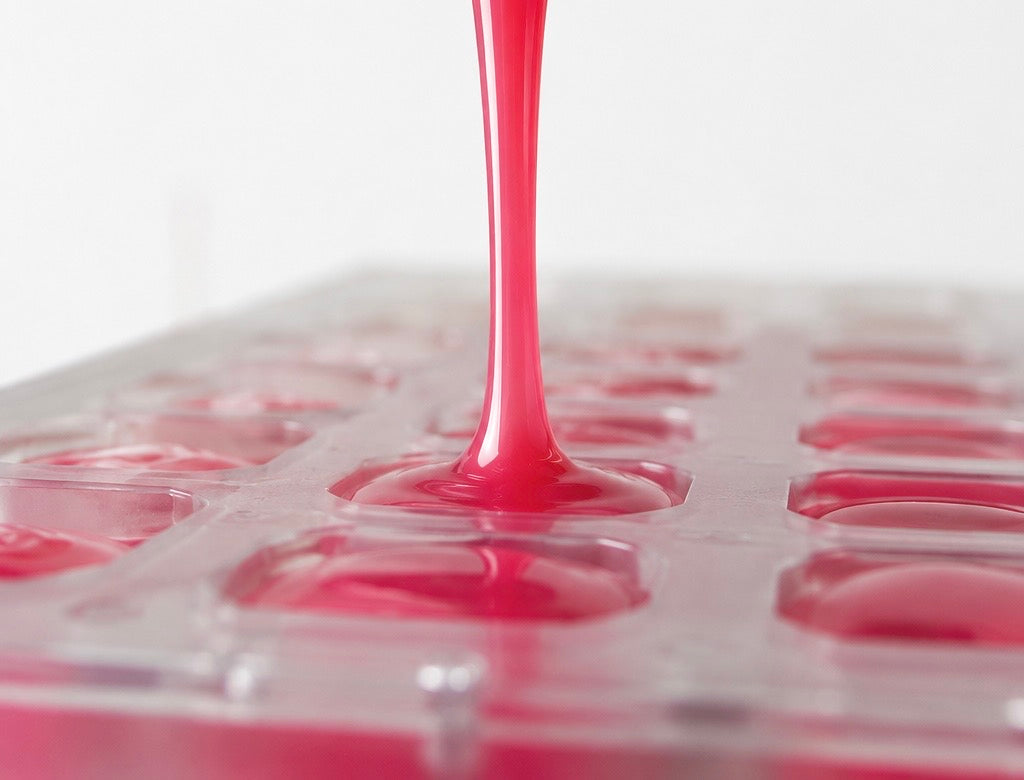
For commercial nutraceutical brands and contract manufacturers (co-packers), a gummy is no longer classified as a confection—it is a delivery vehicle for precise active ingredients. When manufacturing vitamin, protein, or creatine supplements, the single greatest point of operational failure occurs inside the mold cavity itself. Slight changes in a mold’s dimensional stability lead to volumetric variance, throwing off active milligram targets and exposing brands to catastrophic legal and compliance liabilities.
Achieving absolute calibrated volumetric uniformity across high-speed manufacturing lines requires a complete shift away from standard, retail-grade silicone toward heavy industrial silicone layouts calibrated natively for automated machinery.
The Physics of Dosing Accuracy: Fluid Volume vs. Active Mass
In candy manufacturing, a variance across a batch means a slightly larger piece of candy—an unnoticeable defect. In nutraceutical gummy production, that same variance completely compromises the active ingredient dosage uniformity.
Because active raw ingredients (like adaptogens, vitamin complexes, or branched-chain amino acids) alter the specific gravity and viscosity of a cooked pectin or gelatin slurry, the physical mold matrix must be engineered to a flawless tolerance.
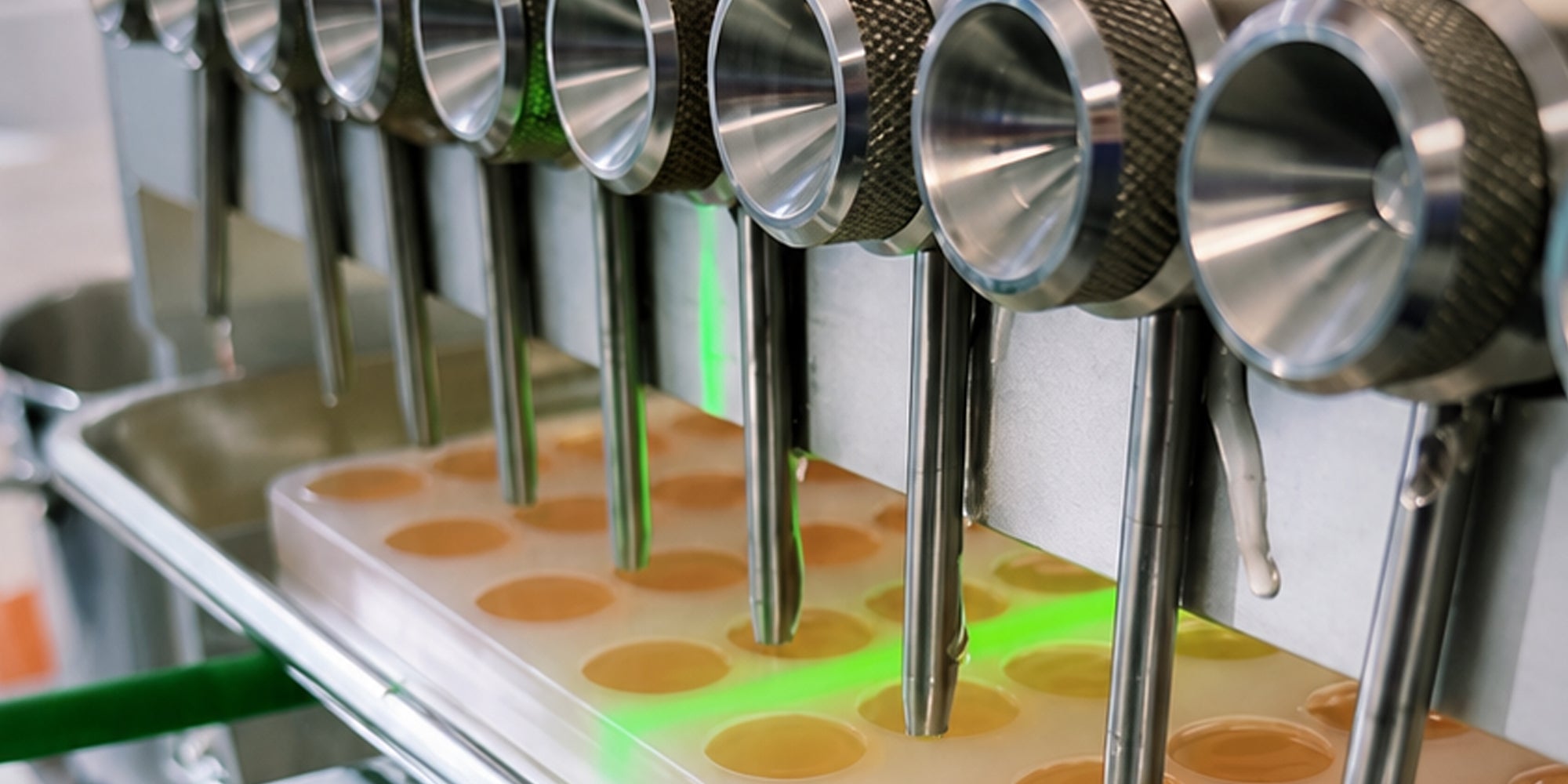
When your depositor pumps a precise volumetric stroke, the fluid must settle into an identical cavity layout across the entire carrier plate. If a silicone mold experiences micro-warping under high-heat depositing kitchens ( to ), the cavity volume changes mid-run. This creates unequal mass displacement, resulting in some gummies being under-dosed while others exceed legal regulatory thresholds.
Why Platinum-Cured Industrial Silicone is Non-Negotiable
Not all silicone hardware handles commercial manufacturing loads equally. Standard tin-cured silicones or cheap filler-blends exhibit high linear shrinkage rates and lack structural rigidity.
To maintain strict compliance across millions of execution cycles, production facilities must rely exclusively on 100% US-Sourced Platinum-Cured Silicone.
Material Specifications Comparison for B2B Operations:
| Engineering Parameter | Vector Molds Platinum Industrial Silicone | Standard Commercial Grade Silicone |
| Linear Shrinkage Rate | Less than 0.1% over 1,000 runs | 2.5% to 4.0% (Causes cavity shrinkage) |
| Thermal Operating Window | to Continuous | to (Deforms under slurry heat) |
| Durometer Shore Rating | Optimized 40 - 50 Shore A | 20-30 Shore A (Too soft; walls flex during scraping) |
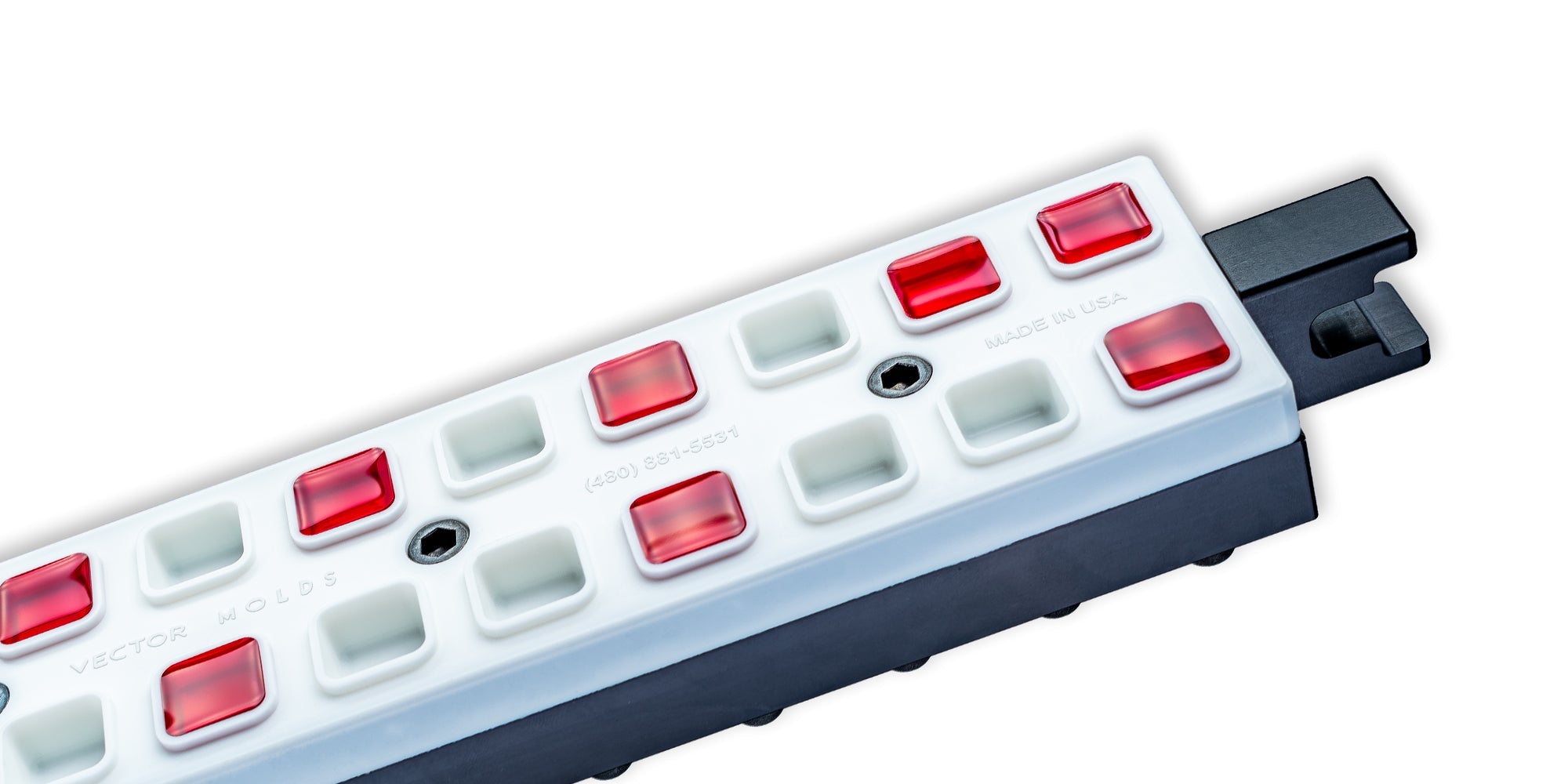
Platinum-cured compounding eliminates chemical outgassing and ensures the silicone mat retains its exact dimensional layout. Whether you run a manual Flood & Scrape system or an automated carrier plate matrix, the side-walls of each cavity must resist the mechanical pressure of pneumatic scrapers or depositor pump strokes without flexing.
📈 Long-Term Efficiency: Demolding Gets Easier with Time
A major competitive advantage of our proprietary platinum-silicone matrix is its performance longevity. Standard molds degrade over time, building up micro-pitting that traps gelatin residue and jams automated ejection machinery.
Vector Molds behave completely differently. As our platinum silicone endures repeated depositing runs, the continuous thermal processing creates a hyper-stabilized, polished finish inside the cavity walls.
This means that demolding the final product becomes significantly easier over time. Your high-velocity air-ejection lines or mechanical pins experience lower physical resistance cycle after cycle, accelerating your total daily throughput, minimizing automated line stops, and slashing maintenance downtime.
🛠️ Optimizing Commercial Silicone Mold Layouts
Designing an effective commercial silicone mold layout involves strategic placement and configuration of hundreds or even thousands of individual gummy cavities on a single industrial mat. Several key considerations come into play:
1. Cavity Spacing and Density
The distance between individual gummy cavities is critical. Too close, and the silicone may not have sufficient structural integrity, leading to deformation during filling or mechanical scraping. Too far, and production efficiency suffers due to lower cavity counts per sheet. Optimal spacing ensures:
-
Structural Support: Sufficient silicone between cavities prevents warping and maintains cavity integrity under continuous depositor pump pressures.
-
Demolding Ease: Adequate space allows for easy separation of gummies without tearing or edge damage during automated air-ejection cycles.
- Efficient Filling: Proper spacing facilitates a smoother, unhindered flow of the gummy mixture across the matrix surface.
2. Runner and Gate Design for Even Flow
The "runner" is the channel that distributes the gummy mixture from the filling machine, and "gates" are the small openings that lead into each individual cavity. Optimized runner and gate systems are essential for volumetric uniformity:
-
Symmetry: Runners must be designed symmetrically to ensure the liquid mixture reaches all parts of the mold matrix with equal pressure and flow rate.
-
Sizing: The diameter and length of runners and gates must be calibrated precisely to prevent premature setting of the mixture or air entrapment.
-
Placement: Gates are typically placed at the bottom or center of the cavity to promote even filling from the base upwards, minimizing structural anomalies.
3. Airflow and Cooling Considerations
During the setting process, heat transfer and potential air entrapment are significant. Mold layout directly influences these factors:
-
Ventilation Channels: In advanced designs, micro-channels are incorporated to allow trapped air to escape smoothly during filling, eliminating surface pits.
-
Uniform Cooling: The structural density of cavities impacts how uniformly the molds cool, which in turn affects setting times and final texture stability.
4. Withstanding the Shock: Hot-Cold Hard Cycles
The commercial gummy manufacturing process is brutal on tooling material. Molds must survive continuous hot-cold hard cycles: moving instantly from the intense heat of the depositing kitchen ( slurry pumping) directly into high-velocity multi-stage cooling tunnels or flash-freezing stabilization lines, and then immediately cycling back to the heat of the depositor.
Vector Molds’ heavy industrial compounding utilizes 100% US-Sourced Platinum-Cured Silicone, engineered with elite cross-linked polymers that effortlessly endure these repeating temperature shocks.
📈 Long-Term Efficiency: Demolding Gets Easier with Time
A major competitive advantage of our proprietary platinum-silicone matrix is its performance longevity. Standard molds degrade over time, building up micro-pitting that traps gelatin residue and jams automated ejection machinery.
Vector Molds behave completely differently. As our platinum silicone endures repeated depositing runs, the continuous thermal processing creates a hyper-stabilized, polished finish inside the cavity walls.
This means that demolding the final product becomes significantly easier over time. Your high-velocity air-ejection lines or mechanical pins experience lower physical resistance cycle after cycle, accelerating your total daily throughput, minimizing automated line stops, and slashing maintenance downtime.
💎 Advanced Techniques and Future Trends
As the nutraceutical gummy sector matures, so do the technologies employed in mold design:
-
Multi-Layer Molds: For complex, functional, or dual-layer gummies, sophisticated multi-stage mold designs are emerging to isolate specific active compounds.
-
Automated Design Software: Computational fluid dynamics (CFD) and advanced CAD software are used to simulate flow and stress, optimizing layouts before physical CNC prototyping.
-
Robotic Demolding: The precision required for robotic handling reinforces the need for perfectly uniform, high-durability gummies that release cleanly without deformation.
❓ Frequently Asked Questions
Q1: What is calibrated volumetric uniformity in gummy manufacturing?
A1: Calibrated volumetric uniformity is the engineering standard where every single cavity inside a commercial silicone mold is manufactured to an identical, precise fluid volume tolerance—maintaining a variance threshold under . This guarantees that when an automated depositor pumps a precise stroke of slurry, the final mass displacement yields consistent milligram dosing across millions of supplement gummies.
Q2: Why is platinum-cured silicone mandatory for nutraceutical gummy production?
A2: Platinum-cured silicone is mandatory because it provides total chemical purity, zero gas emission, and elite dimensional stability. Unlike cheap tin-cured silicones that suffer from linear shrinkage rates up to 4%, platinum-cured silicone keeps its shrinkage under 0.1%, ensuring that the target cavity size never alters during long-term commercial production.
Q3: How do runner and gate configurations impact active ingredient dosing?
A3: Runner and gate layouts dictate the flow pressure and fluid velocity of the cooked slurry as it fills the mold matrix. Symmetrical runner paths ensure identical pressure reaches every cavity. Uncalibrated runner systems cause uneven pressure drops, leading to incomplete fills, air entrapment, and severe volumetric variance that compromises legal dosage compliance.
Q4: Does gummy demolding get harder or easier as a silicone mold ages?
A4: With Vector Molds' premium platinum industrial silicone, demolding becomes significantly easier with time. While low-tier molds degrade and pit over time, our high-durability polymer matrix undergoes a natural micro-surface conditioning through repeated high-heat exposure, creating a smoother release finish inside the cavity walls. This reduces drag, allowing automated ejection pins and pneumatic air sweeps to effortlessly drop final gummies without tearing.
Q5: Can custom mold layouts be optimized for specific machinery brands?
A5: Yes, our commercial layouts are custom-engineered to integrate with heavy machinery lines, including Universal Depositor systems, Baker Perkins lines, and automated carrier plate setups. We align the grid density and runner systems directly to your machinery's specific center-to-center nozzle pitch, ensuring perfect operational synchronization.
📋 Overview
-
Target Audience: Commercial supplement innovators, contract manufacturers, and processing engineers looking to scale high-capacity active confectionery production lines.
-
Core Problem: Improper cavity configurations, uncalibrated flow vectors, and cheap materials cause active ingredient dosing variance, micro-warping, and line shutdowns.
-
The Solution: Implementing custom-engineered, multi-cavity platinum-silicone layouts with symmetrical runner gates designed specifically for continuous mechanical line pressures.
-
Key Technical Benefits: Guarantees structural volumetric compliance, ensures complete resistance to high-frequency hot-to-cold thermal shock cycles, and utilizes micro-surface curing to improve automated demolding performance over time.
Share:
Wellness Gummies & the Future of Commercial Gummy Manufacturing
How Integrated Ejector Systems Save Copacker Workflows